
Various transparency related negotiations and events are on the agenda for COP28. In this blogpost I provide a brief overview of four key agenda items. With the transition to the enhanced transparency framework in 2024 around the corner, negotiations at this COP provide an opportunity to shape the new and revisit the old.
1. On the agenda: Support to developing countries for the enhanced transparency framework
Developing countries are not all happy with how support for climate transparency is organized. To address this, the previous CMA (at COP27 in Egypt) was to decide on how to improve the situation. But to no avail. Negotiations continued over the past year and at COP28, countries have another chance to come to agreement.
At the heart of the matter is the question of whether processes under the Global Environmental Facility (GEF), a multilateral fund, should be changed. To prepare for the negotiations in Dubai, countries were invited to make submissions- a good avenue to see what different countries want.
So what do countries want?
The EU, for example, sees various options to deal with capacity challenges. Many of those are for developing countries themselves to take up, such as better defining domestic ‘roles and responsibilities for data collection’ or setting up domestic archiving systems. The EU also sees potential in remote sensingto provide the data for greenhouse gas inventories, especially for countries that do not have the capacity to collect data locally. The US further highlights various existing capacity building initiatives and adds that participation in the transparency arrangements is itself a good way to build capacities and continuously improve.
But some developing countries argue that processes under the Global Environmental Facility need to be changed. First, there is the issue of the amount of funding ($484,000 dollars to prepare one biennial transparency report) is considered insufficient. But that is not the only issue. Argentina, Brazil and Uruguay add that accessing funds is a lengthy process, which is especially problematic for something that has to be done every two years.
South Africa, further adds that the problem also lies in how funds can be spent and that this currently often results in the hiring of consultants rather than establishing posts in the government, which in their view “traps developing countries like South Africa in a perpetual cycle of relying on external service providers instead of building fully functional national systems.”
The LMDC group proposes to establish the ‘Dubai Transparency Platform’ that would run from 2024-2028 to provide additional financial, technical and capacity building support to developing countries, as well as providing a platform for sharing of experiences that could feed into the scheduled revisions of the ETF rules (MPGs) in 2028.
Support for climate transparency was a core part of the enhanced transparency framework’s compromise under the Paris Agreement. But the devil is in the detail. COP28 offers an opportunity to re-negotiate and improve international support for climate transparency.
2. Back on the agenda: Information contained in National Communications of developing countries
This curious agenda item has been held in abeyance for a long time through various COP agendas. In 2005 the UNFCCC secretariat published a ‘compilation & synthesis report’ of developing countries’ national communications (transparency reports to be submitted every four years). But Brazil contested the way in which the secretariat calculated CO2-equivalent emissions from non-CO2 greenhouse gasses. Brazil argued the methodology used by the secretariat overestimates emissions from short-lived gasses (like methane, which is prevalent in Brazil’s agriculture industry) while underestimating CO2 emissions. Moreover, Brazil considered it inappropriate how Secretariat singled out specific countries in some of the graphs in addendum 2 of the report, for example the figure below.
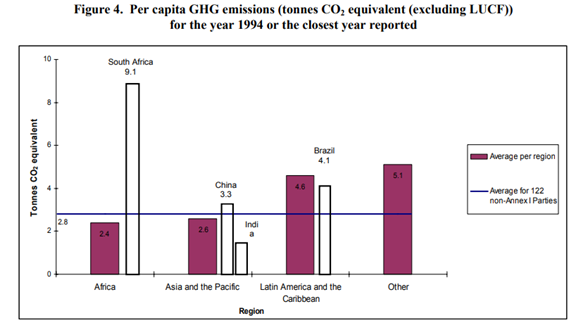
Source: UNFCCC (2005) ‘Sixth compilation and synthesis of initial national communications from Parties not included in Annex I to the Convention’, p. 10, UN Docs. FCCC/SBI/2005/18/Add.2, available at: https://unfccc.int/sites/default/files/resource/docs/2005/sbi/eng/18a02.pdf.
A matter open to interpretation at the time as well was whether such a compilation and synthesis report of non-annex I countries, and consideration thereof by the COP would also apply to future national communications (beyond the initial national communication). Australia on behalf of the Umbrella group was of the view that it should. The report of the SBI24 session (para 32) merely takes note of Australia’s intervention.
Fast forward to the present and the agenda item has been held in abeyance ever since and no subsequent compilation and synthesis reports have been prepared for later rounds of national communications of non-annex I Parties. But in Bonn, earlier this year (2023), consultations took place on this agenda item that had been held in abeyance for so long and the SBI took note (agenda item 4(a)) of the status of submissions of biennial update reports and national communications. Some in the hallways whisper that there is a chance that COP28 will see further movement on this agenda item.
This is all particularly interesting, because in the hallways divergent views are shared on the continuing utility of national communications under the Convention when there is biennial reporting under the Paris Agreement. Developing countries want to keep the national communication process. One of the reasons is that the National Communications are under the Convention and guided by its principles. Moreover, the national communications provide ample space to report in detail on adaptation and vulnerability. Finally, and linking to the previous section, support for national communications is a substantially larger sum of money than for the new biennial transparency reports (even though countries can also apply for a joint grant to write both at once). Whether the revival of this agenda item will change the dynamics over the continued relevance of national communications remains to be seen.
3. Always on the agenda: The search for enhanced ambition (with implications for transparency)
Zooming out a little bit, we are also interested in a larger question: how is transparency implicated in efforts to drive enhanced ambition?
As discussed in previous blogs about COP27 (see here and here) transparency is often actually detached from the places where enhanced ambition is explicitly discussed. How will this pan out at COP28? There are a number of agenda items explicitly or implicitly dealing with the question of enhanced ambition. Here we discuss how transparency is or could be implicated.
First, CMA5 will see a ‘high-level ministerial round table on pre-2030 ambition.’The proceedings of last year’s round table do not include a single mention of the transparency framework or transparency reports submitted under it. A particularly pertinent document that should feed into this round table is the secretariat’s compilation and synthesis report of developed countries’ fifth biennial reports. In particular, the round table should take note of paragraph 182 which states that “projections from the BR5s indicate that no Party will achieve its targeted level of emissions in 2030 set out in its NDC.” This information, coming from the UNFCCC’s transparency arrangements, is particularly important in the context of discussing pre-2030 ambition- but whether it will actually feed into the discussion remains to be seen.
Second, the ‘Sharm el-Sheikh mitigation ambition and implementation work programme’ is on the agenda. As discussed in a previous blog, parties did not include transparency reports as a specific input into this work programme. The workpramme now centers around Global Dialogues that in 2023 centered around the topic of ‘just energy transition’ and investment-focused events. This is a far cry of what was on the table when the focus of the work programme was discussed in 2022.
Back then, transformative options were on the table (as expressed in an informal note). For example, developed countries proposed “enhancement of NDCs, including sectoral commitments” and the creation of “recommendations and road maps for delivering sectoral commitments.” Some developing countries feared that quantified targets could mean “imposing similar mitigation targets and goals for all Parties by or around mid-century without providing means of implementation for developing countries” and they argued for “the operationalization of the equitable distribution of the carbon budget, taking into account the historical responsibility of developed countries and climate justice.” And linked to this, were also proposals for new tracking, including tracking progress against sectoral benchmark indicators and a ‘global carbon budget tracker’. In the end, sectoral targets nor the carbon budget made it into the new mitigation work programme and no new tracking systems were developed. But these discussions remain at the heart of enhancing ambition.
Indeed, and thirdly, the first global stocktake, will likely see these issue flare up as well. The synthesis report of the technical dialogues under the global stocktake mentions, for example, the need for ‘systems transformations across all sectors’ but also that ‘equity can increase ambition.’ It does not, however, mention the ‘carbon budget’ as a way to operationalize this.
Will the political phase of the global stocktake make headway on these matters? This remains to be seen. The synthesis report lists a number of procedural follow-up activities, with the first one being the submission of biennial transparency reports. While the biennial transparency reports and new nationally determined contributions allow individual countries to reflect in these documents on the principle of equity and sectoral efforts, there are further avenues to discuss these multilaterally at COP28.

Source: Technical dialogue of the first global stocktake: Synthesis report by the co-facilitators on the technical dialogue. Available at: https://unfccc.int/sites/default/files/resource/sb2023_09E.pdf.
Here a fourth, and particularly interesting, (provisional) agenda item for COP28 enters the picture: the LMDC group proposed a new agenda item titled: ‘Operationalization of the principles of equity and common but differentiated responsibilities and respective capabilities, in accordance with Article 2, paragraph 2, of the Paris Agreement.’ Their submission does not reveal in detail what this group hopes to discuss under this agenda item. But the idea is probably to give a counterweight to the pre-2030 ambition round table and the mitigation work programme, that are more anchored in ambition than equity. Another point that might be raised is the carbon budget, and how to ensure equitable access to it.
Another agenda item of interest here is the ‘Second review of the adequacy of Article 4, paragraph 2(a–b), of the Convention.’ The first review took place in 1995 at the first COP and the review concluded that Article 4.2 is not sufficient, and this resulted in the launch of Kyoto Protocol negotiations.
The second review was initially on the agenda for COP4. But it proved impossible to reach consensus, and it has ever since. A key bone of contention is whether it is within the scope of the review to discuss if article 4.2 is insufficient in the sense that it does not apply to developing countries. For example, the United States proposed that the outcome of the review “Confirms that action by developed country Parties and other Parties included in Annex I alone will not be adequate to meet the objective of the Convention.” The G77 and China, instead wanted to focus on mitigation commitments of developed countries.
Later at COP7, the G77a and China proposed to reformulate the agenda item as “review of the adequacy of implementation of Article 4.2(a) and (b)” [emphasis added]. This would resolve different interpretations on what it is exactly that is to be reviewed, and whether this could result in more action being required from developing countries (see here for a detailed analysis).
The item is again on the agenda for COP28. Most likely it will be held in abeyance. But the balance of interests may start to change. Some developing countries are afraid that the Paris Agreement is increasingly being put to the fore while the Convention recedes to the background. The Convention is anchored more strongly in principles of equity and common but differentiated responsibilities. To bring the Convention back into the picture it may help to bring such agenda items, that have been held in abeyance for a long time, back alive.
4. Soon-not-anymore on the agenda: Developed countries under scrutiny during multilateral assessments
Another process that is in transition is the Multilateral Assessment of biennial reports submitted by developed countries. From next year onwards developed countries will submit biennial transparency reports that undergo a process of Multilateral Consideration of Progress with common rules for developed and developing countries. One consequence may be a dilution in attention and rigour of the assessment of developed countries’ reports. Extra reason thus to take closer look of the last Multilateral Assessment for a group of developed countries scheduled to undergo this at COP28.
A number of important developed countries are set to undergo multilateral assessment at COP28. But soon the Multilateral Assessment will be replaced by a potentially more ‘soft’ Facilitative, Multilateral Consideration of Progress. Will COP28 end the multilateral assessment tradition with a bang? These are the ones to follow.
First, the Netherlands is up for review. One interesting point here is that in the Netherlands the highest court ruled that the country had to reduce emissions by at least 25% by 2020 below 1990 levels. Now the numbers are out and the government claims in its climate report to have reduced emissions by 25.5% (in the 2020 year of COVID lockdown). It will be interesting to see if anything related to this comes up in the verbal question and answer session at COP28.
In addition, Japan asked posed an interesting pre-session written question to the Netherlands: “According to the projection results provided on p156-157 of the NC8, the emission reduction target of 55% reduction of national total emissions from 1990 level by 2030 will not be reached under any of the “With Existing Measures” (WEM) scenario, the “With Additional Measures” (WAM) scenario, or the “With Scheduled Measures” (WSM) scenario. How are the results of the projections reported in the NC and the BR used in future policy making?”
Second, the EU is up for multilateral review. One interesting question posed by Canada points to a potential accounting ‘trick’ that makes the 55% reduction target of the EU look larger than it actually is. It will be interesting to see how the EU responds to this.
Finally, the US will undergo multilateral assessment. Again, some interesting questions set the tone for the session in Dubai. New Zealand asks in a pre-sessional written question “what measures has the US taken to reform, reduce and remove harmful fossil fuel and agricultural subsidies?” And further poses the questions “To what extent did the United States fossil fuel production increase or decrease over the period 2013-2020? What measures exist around approving new fossil fuel expansion?” Japan further asks “In the summary table of policies and measures, “direct ocean capture with durable storage” is mentioned as a CDR technology the program invests. What is technology or process considered as direct ocean capture?”
What this shows is that the Multilateral Assessment sessions may not be a merely procedural affair or an exchange of compliments. But whether the sessions will generate any tracking beyond the usual crowd of transparency experts remains to be seen.
5. Conclusion
COP28 will see push and pull on the transparency rules in various avenues. The red thread here is the transition from reporting and review under the Convention to the Paris Agreement.
Some contestations discussed above are about the new system under the Paris Agreement. Countries will discuss how support for reporting is organized, especially now that more rigorous and continuous reporting is required from developing countries.
But with the new becoming operational, a latent discussion is what to make of the old. Developed countries might seek to subtly ‘sunset’ every more processes under the Convention, and reporting might be one of them. Developing countries, however, do see continued relevance in reporting under the Convention. And there might even be an opening to reinstate synthesis reports of developing countries’ national communications.
Meanwhile, this COP will see several major developed countries undergo their last Multilateral Assessment and the principles and framing of Paris Agreement’s Facilitative, Multilateral Consideration of Progress are softer.
For now, transparency, with all its elaborate reporting and review, seems to remain rather detached from the venues where ambition is discussed. The big question is whether this dynamic will change in 2024 when both developed and developing countries are subject to the same transparency framework.
TRANSGOV representatives will be at COP28 to cover the latest transparency developments. Follow daily updates via the TRANSGOV twitter. For your reference, please find in the annexes below an overview of key transparency related events and publications for COP28.
Annex A: Key transparency events at COP28
Side events
| Day | Time | Location | Title |
| Friday, 01 Dec | 16:45—18:15 | SE Room 1 | Enhanced Transparency for Small Island Developing States |
| Friday, 01 Dec | 18:30—20:00 | SE Room 1 | Navigating Technical Expert Review under the ETF: Leveraging Existing MRV Insights for Success |
| Sunday, 03 Dec | 16:45—18:15 | SE Room 1 | Harnessing Transparency for Ambitious NDC Implementation in Central Asia |
| Monday, 04 Dec | 11:30—13:00 | SE Room 6 | Is the looking glass half full or half empty? Transparency for climate discussions and reporting |
| Monday, 04 Dec | 13:15—14:45 | SE Room 1 | Key tools supported by the UNFCCC secretariat to strengthen the ETF |
| Monday, 04 Dec | 15:10 – 16:10 | Capacity building Hub | Measuring capacity progress in climate transparency under the GST |
| Tuesday, 05 Dec | 13:15—14:45 | SE Room 2 | Enabling climate action through data, transparency and finance |
| Wednesday, 06 Dec | 11:30—13:00 | SE Room 6 | Satellite Observation contributing to GHG inventory, NDCs, and GST |
| Friday, 08 Dec | 11:30—13:00 | SE Room 5 | Benefits and burdens: Developing country experiences with participation in transparency arrangements |
| Friday, 08 Dec | 13:15—14:45 | SE Room 5 | Achievements of the CGE, upcoming activities and national insights on the preparation of BTRs |
| Saturday, 09 Dec | 18:30—20:00 | SE Room 2 | Nigeria and Sustainable Energy Africa (SEA), Monitoring & Evaluation of Just Transitions Event |
| Sunday, 10 Dec | 16:45—18:15 | SE Room 9 | Earth observations in support of mitigation actions towards the Paris climate goal and SGDs |
| Monday, 11 Dec | 11:30—13:00 | SE Room 7 | Climate Finance Transparency: a harmonized framework to mobilize public and private finance |
Also keep an eye out for the UNFCCC’s transparency calendar.
Annex B: Key recent publications
| Title | Organizations | Annotation |
| Benefits of Climate Transparency | PATPA, UNFCCC | This publication discusses the benefits of participation in climate transparency arrangements. It also includes various country case studies. |
| Trust and Transparency in Climate Action: Revealing Developed Countries’ Emission Trajectories | CEEW, Wageningen University & Research | This publication uses information as disclosed by developed countries in their biennial reports to shed a light on their mitigation performance. |
| A fit for purpose approach for reporting and review under UNFCCC’s Enhanced Transparency Framework | Tinus Pulles & Lisa Hanle | This publications highlights the logistical challenges related to the enhanced transparency framework, and offers suggestions for how to deal with them. |
| Opening the Black Box of Transparency: An Analytical Framework for Exploring Causal Pathways from Reporting and Review to State Behavior Change | Ellycia Harrould-Kolieb, Harro van Asselt, Romain Weikmans & Antto Vihma | This publication explores the relationship between participation in global transparency systems and state behavior change. |
 TRANSGOV