
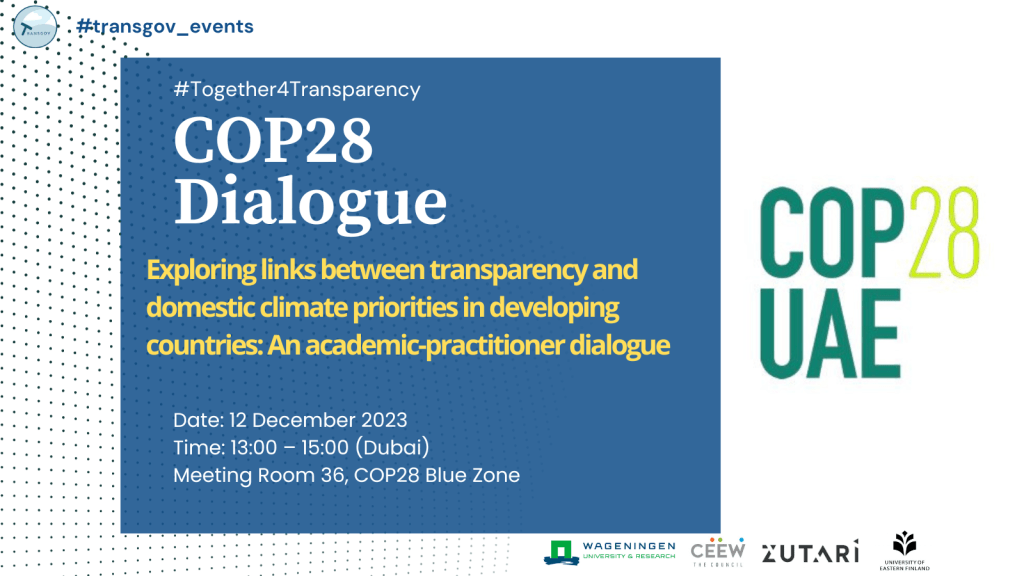
Exploring links between transparency and domestic climate priorities in developing countries: An academic-practitioner dialogue
Tuesday, 12 December 2023
13:00—15:00 (Gulf Standard Time, GMT+4)
COP28 venue, meeting room 36
Live webcast
Context
The Enhanced Transparency Framework (ETF) of the Paris Agreement contains a detailed set of reporting and review provisions that aim to make visible how countries perform vis-à-vis their climate targets. As of 2024, the enhanced transparency framework requires all countries to submit Biennial Transparency Reports. This represents a substantial increase in stringency of reporting rules for developing countries.
Academic literature and practitioner experiences suggest that adherence to UNFCCC transparency arrangements can be a challenging endeavor for developing countries. By illustration, only 12 developing countries managed to submit a 4th Biennial Update Report under pre-Paris transparency rules. This illustrates the magnitude of the challenge now that developing countries face more stringent requirements from 2024 onwards.
To make the transition to the Enhanced Transparency Framework, substantial time and resources are being invested in setting up domestic systems. While this is a challenge, it may also present unique opportunities. Beyond adhering to transparency arrangements, it is imperative to explore ways to make sure participation in transparency arrangements delivers domestic benefits and contributes to domestic climate action priorities.
Objective
This workshop convenes internationally leading research projects on transparency in climate governance as well as practitioners who have first-hand experience in UNFCCC transparency arrangements. The goal is to draw on both academic work as well as examples from practice to explore the transformative potential of transparency for developing countries, especially in this crucial year of the transition to the enhanced transparency framework.
Speakers

Prof. Aarti Gupta
Wageningen University & Research @AartiGupta17 @Transgov_wur
Aarti Gupta is Principal Investigator of the TRANSGOV project. She is a Professor of Global Environmental Governance with the Environmental Policy Group, Department of Social Sciences, Wageningen University. Her research is in the field of global environmental and climate governance, with a focus on transparency and accountability and the challenges of anticipatory governance of novel technologies, including climate engineering. She has published extensively in these fields, including the edited volume, Transparency in Global Environmental Governance: Critical Perspectives (2014, MIT Press). She holds a PhD from Yale University and is a member of the Scientific Steering Committee of the International Earth System Governance Research Alliance.

Tugba Icmeli
Tugba Icmeli is the Team Lead of the CGE/ETF Support Unit in the Transparency Division of the UNFCCC secretariat. She is responsible for providing technical support and assistance to developing countries on implementing the measurement, reporting and verification (MRV) arrangements under the Convention and the enhanced transparency framework (ETF) under the Paris Agreement. She has more than 20 years of professional experience in environmental management, climate change and project management, both in private and public sectors, including 5 years within the UNFCCC secretariat. She holds M.Sc. degrees in Environmental Engineering and Industrial Engineering.

Dr. Michael Gillenwater
Dr. Michael Gillenwater is Executive Director & Dean of the GHG Management Institute. He is a leading expert on climate change and renewable energy, with a specific focus on greenhouse gas (GHG) measurement, reporting, and verification (MRV) issues. He is a lead author of four Intergovernmental Panel on Climate Change (IPCC) reports. He has participated in the UNFCCC process as a negotiator and an expert for over two decades and developed and taught the courses that certify experts to serve on compliance review teams under the Kyoto Protocol. Michael earned his doctorate from Princeton University’s Science, Technology, and Environmental Policy Program (STEP) in the Princeton School of Public and International Affairs.
Dr. Thapelo Letete
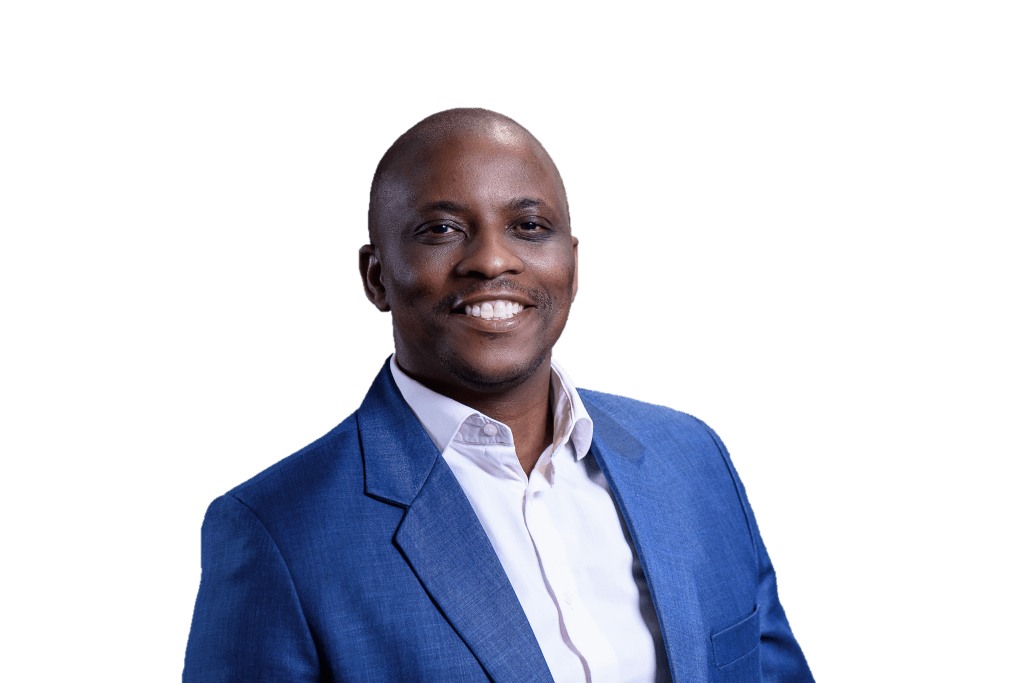
Dr. Thapelo Letete is Director Climate Change at Zutari. Thapelo’s expertise and experience includes greenhouse gas (GHG) inventories and carbon accounting; climate risk, impact and vulnerability assessments; transparency and MRV and development of nationally determined contribution (NDCs) under the Paris Agreement. He is included in the UNFCCC roster of experts as a globally-accredited and experienced expert of GHG inventories, a lead GHG inventory reviewer, a GHG mitigation expert and a general reviewer of country submissions under the UNFCCC, its Kyoto Protocol and its Paris Agreement, with a review record of accomplishment of over 21 countries. Thapelo holds a PhD in Energy and Sustainable development, with a focus on climate change.

Sumit Prasad
Council on Energy, Environment and Water @CEEWIndia
Sumit is a Programme Lead in the International Cooperation team at CEEW. He has led evidence-based research and shed light on pre-2020 climate actions and the implications of transparency arrangement as well as examined other topical issues of international climate governance. He has also authored the MRV chapter in India’s Biennial Update Reports and was nominated by the Government of India to the UNFCCC roaster group of experts.
Programme
| 13:00 – 13:05 | Welcome and Introduction Max van Deursen |
| 13:05 – 14:00 | Presentations (8-10 minutes each) 1. Prof. Aarti Gupta, Wageningen University Perspectives from academia: Assessing the Transformative Potential of Transparency in Climate Governance 2. Tugba Icmeli, UNFCCC Perspectives from practice: Benefits of Climate Transparency 3. Dr. Michael Gillenwater, GHG Management Institute Perspectives from practice: The utility of GHG inventories 4. Dr. Thapelo Letete, Zutari Perspectives from practice: Transparency for domestic climate priorities 5. Sumit Prasad, CEEW Perspectives from non-state actors: Transparency and accountability |
| 14:00 – 14:40 | Round table discussion Introduction to round table discussion format 4 Round tables moderated by Aarti Gupta, Thapelo Letete, Sumit Prasad, Rahwa Kidane Round 1 of table discussion (30 minutes) Round 1 – Report back key messages by moderators (10 minutes) |
| 14:40 – 14:45 | Closing remarks Prof. Aarti Gupta |
| 14:45 onwards | Networking |
Contact
Max van Deursen (Max.vandeursen@wur.nl)
 TRANSGOV