
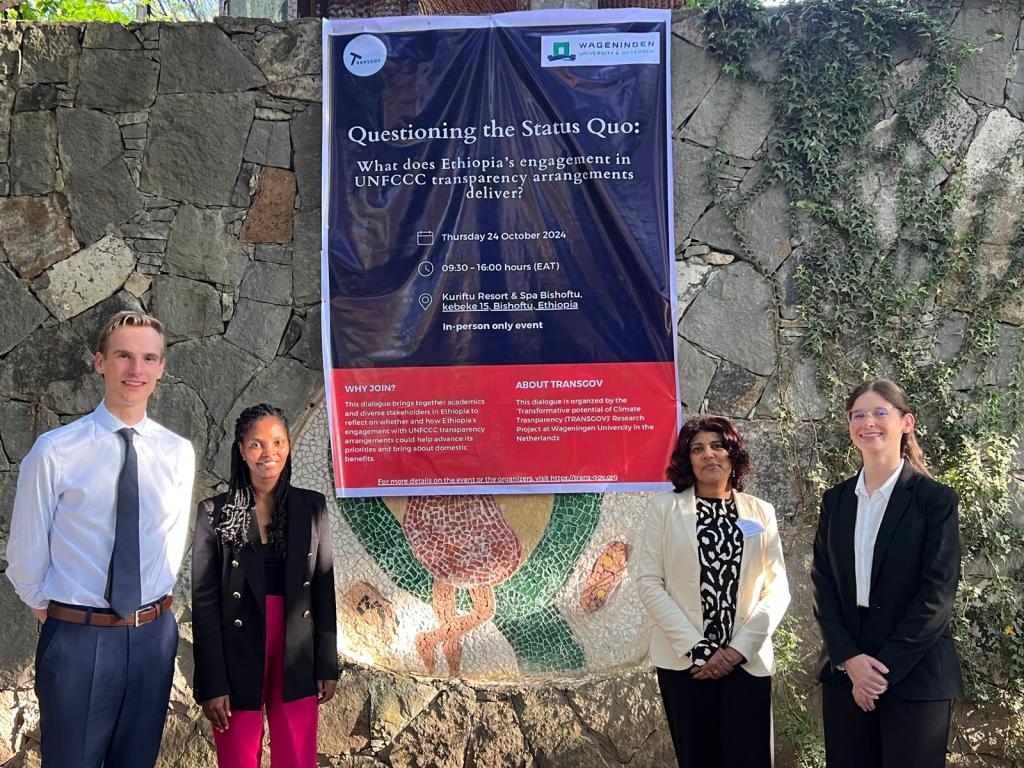
Questioning the Status Quo: What does Ethiopia’s engagement in UNFCCC transparency arrangements deliver?
National stakeholder dialogue with climate transparency researchers
Thursday 24 October 2024, 09:00 – 16:00 hours (EAT)
Location: Kuriftu Resort & Spa Bishoftu, kebeke 15, Bishoftu, Ethiopia
Objective
This dialogue brought together international climate transparency researchers with policymakers and other stakeholders in Ethiopia to reflect on whether and how Ethiopia’s engagement with the United Nations Framework Convention on Climate Change (UNFCCC) transparency arrangements is helping to advance its climate action priorities and generating domestic benefits.
Outcomes
The dialogue was well-attended with over 30 national experts participating in the discussions. Participants included representatives of various line ministries and government agencies, as well as academics and other stakeholders.
Looking back: What has engagement in UNFCCC reporting delivered so far?
In the first interactive session, participants discussed the motivations for Ethiopia’s past engagement in UNFCCC transparency arrangements, as well as what this engagement has so far delivered.
Key drivers of Ethiopia’s engagement include a willingness to comply with international rules, even when these are voluntary. Moreover, reporting is seen as an opportunity to showcase climate leadership to the international community, for example, by emphasizing how Ethiopia has implemented mitigation actions with domestic resources. Relatedly, there is the hope that quantifying and reporting on (potential) mitigation actions might help to attract climate finance, be it through internationally funded projects or carbon markets. Finally, some participants emphasized that engaging in UNFCCC reporting can help with general development planning.
Views diverged on the extent to which past engagement has delivered concrete benefits for Ethiopia. A central concern here was the question of whether (better) reporting has helped to generate climate finance. Some argue that good reporting shows that Ethiopia is acting with international agreements in good faith and therefore can make a justified call for climate finance. Others argued that robust reporting is a prerequisite for many donor-funded projects and carbon markets. Yet others mentioned that other factors drive climate finance allocation, and that engaging in UNFCCC reporting is unlikely to make much of a difference.
Looking forward: Is there a need to question the status quo?
In the second interactive session, participants discussed the question of whether there is a need to re-think how Ethiopia engages with UNFCCC transparency arrangements or if the UNFCCC arrangements themselves need re-imagining.
In terms of how Ethiopia engages with UNFCCC transparency arrangements, some stakeholders were of the view that the focus should be on improving institutional, data management, and technical capacity related to implementing the international reporting requirements, with institutional stability and coordination mentioned as particularly important points. These points were seen as important by most participants, but some also questioned if there are avenues to align reporting more with Ethiopia’s domestic priorities or put such reporting efforts to strategic use. For example, some participants proposed focusing more on reporting on adaptation and loss and damage, as these are key priorities for Ethiopia, even as there is currently little capacity for such reporting. Another suggestion related to leverage the reports more once written, for example in negotiations with international donors.
In terms of re-imagining the UNFCCC transparency rules, a first concern is if there is potentially too much focus on mitigation and too little on adaptation and loss and damage. This relates not only about the reporting rules, but also to (donor funding for) trainings and capacity building programmes for reporting. Additionally, some participants argued that reporting by donors on climate finance provided requires more stringent and common rules related to what can be counted as climate finance. Some participants were hopeful that the new rules under the enhanced transparency framework (where the donor reports on support provided and the recipient on support received) will provide more clarity. Others argued that negotiating common definitions and methods is necessary.
Synthesis
The workshop has showed that there is not one straightforward answer to the question: ‘What does Ethiopia’s engagement in UNFCCC transparency arrangements deliver?’ To some, the act of generating new data and publishing this in the public domain in accordance with international reporting guidance is in itself a key achievement. To others, Ethiopia’s efforts to generate transparency reports in good faith with international provisions has not delivered what is crucially needed: substantial amounts of climate finance for climate resilience and the green economy. In both interpretations, a valid question remains how reporting can be better aligned with domestic priorities. And this workshop yielded some proposed avenues to do so, for example through more focus on reporting on adaptation and loss and damage. Re-imagining the UNFCCC transparency rules themselves is a complex endeavor, but ultimately of key importance to make transparency deliver on its transformative promise. And such reforms may not only need to focus on reporting by developing countries. Indeed, one of the core opportunities for strengthening the reporting rules proposed in this workshop related to climate finance reporting by developed countries.
Background and Context
Ethiopia has been actively involved in international climate change efforts since the 1990s, ratifying the United Nations Framework Convention on Climate Change (UNFCCC) in 1994 and the Paris Agreement in 2017. The primary goal of this international agreement is to limit the rise of human-caused global temperature while requiring signatories to be transparent about their climate actions, especially those related to climate mitigation. Although not mandatory for Least Developed Countries (LDCs), Ethiopia has engaged in the UNFCCC transparency requirements by submitting three National Communications (NCs) and one Biennial Update Report (BUR).
Engaging with the UNFCCC through transparency reporting is often assumed to provide domestic benefits, such as utilizing these reports in policy formulation, attracting international climate finance, and participating in future carbon markets. In practice, however, it is unclear whether this engagement is delivering these domestic benefits for Ethiopia. Another unexplored yet contested topic is whether LDCs such as Ethiopia, which have an insignificant contribution to global greenhouse emissions, should prioritize (reporting on) mitigation actions (as required by the UNFCCC) over their other urgent development challenges.
The international research project ‘Assessing the Transformative Potential of Climate Transparency’ (TRANSGOV), based at Wageningen University in the Netherlands, addresses these knowledge gaps. TRANSGOV’s research has produced several key insights that challenge the status quo of what is believed to be the enabling role of ever-greater levels of transparency in climate governance, whereby transparency is assumed to enhance accountability, mutual trust and improved domestic decision-making. These findings suggest that the current status quo of (largely mitigation-focused) climate reporting may not be conducive (and potentially even be a hurdle) to realizing specific domestic climate action priorities in LDCs.
In 2024, a new Enhanced Transparency Framework (ETF) under the Paris Agreement is becoming operational, under which even more stringent mitigation-related transparency is now required from countries. Adherence to this new framework through submitting Biennial Transparency Reports (BTRs) is mandatory for most countries but still voluntary for LDCs. Ethiopia has already expressed interest in submitting a BTR to the UNFCCC. Consecutively, international capacity-building support initiatives are underway to help the country comply with this specific
transparency requirement. This is a thus crucial moment to assess whether and how the country’s previous engagement with the UNFCCC has yielded domestic benefits. It is timely to ask: What does Ethiopia’s engagement in UNFCCC transparency arrangements deliver? Where should Ethiopia’s reporting priorities focus, and what technical capacity-building support is needed to realize such priorities? The TRANSGOV research project facilitates interactive discussion of these questions during this national stakeholder dialogue.
Speakers

Prof. Aarti Gupta
Wageningen University & Research
Aarti Gupta is a Professor of Global Environmental Governance with the Environmental Policy Group, Department of Social Sciences, Wageningen University, the Netherlands, and Principal Investigator of the TRANSGOV project. She has a long-standing research record on climate transparency and climate governance, as well as the contested international politics of climate change.

H. E. Seyoum Mekonena
Ministry of Planning and Development, Ethiopia
H. E. Seyoum Mekonena is Ethiopia’s State Minister of Planning and Development in charge of Environment and climate change and population and development. He has extensive experience in various leadership positions with responsibility for institutional development, strategic planning, and fostering collaboration among diverse sectors to achieve national development goals.

Rahwa Kidane
Wageningen University & Research
Rahwa Kidane Rahwa Kidane is a postdoctoral researcher with the Environmental Policy Group, Department of Social Sciences, Wageningen University, the Netherlands. Her current research focuses on international adaptation finance flows to Ethiopia. She also possesses in-depth knowledge of Ethiopia’s engagement with the UNFCCC and its national circumstances.

Max van Deursen
Wageningen University & Research
Max van Deursen Max van Deursen is a researcher with the TRANSGOV Project at the Environmental Policy Group, Department of Social Sciences, Wageningen University, The Netherlands. His research focuses on assessing how participation in UNFCCC climate transparency arrangements relates to domestic climate action, with a focus on India and South Africa.
Programme
| 9:00 | Registration |
| 9:30 | Welcome and opening Prof. Dr. Aarti Gupta, Wageningen University & Research H. E. Seyoum Mekonena, State Minister of Planning and Development, Ethiopia |
| 9:50 | Interactive introduction of participants |
| 10:30 | Transparency in climate governance: Introductory presentations 1. TRANSGOV Project: Examining the role of transparency in global climate governance Dr. Aarti Gupta, Wageningen University & Research 2. What are the UNFCCC transparency arrangements? Mr. Max van Deursen, Wageningen University & Research 3. Ethiopia’s engagement in UNFCCC transparency arrangements Dr. Rahwa Kidane, Wageningen University & Research |
| 11:00 | Coffee break |
| 11:15 | Interactive session 1: What has engagement in transparency arrangements delivered? In this interactive session, we will discuss Ethiopia’s past engagement with UNFCCC transparency arrangements. Ethiopia has submitted three National Communications (NCs) and one Biennial Update Report (BUR). We will discuss what the utility and impact of generating such reports has been for Ethiopia. |
| 12:45 | Lunch break |
| 14:00 | Interactive session 2: How to shape future engagement in transparency arrangements? In this interactive session, we will look ahead to Ethiopia’s future engagement with UNFCCC transparency arrangements. We will explore the question: where should Ethiopia’s future reporting priorities to the UNFCCC focus on, and how can international capacity-building efforts support these priorities? |
| 15:30 | Closing and reflection |
| 16:00 | Snacks and networking |
Contact
Rahwa Kidane (rahwa.kidane@wur.nl)
This TRANSGOV event is financed by the Netherlands Organisation for Scientific Research (NWO) Impact Explorer.

 TRANSGOV