
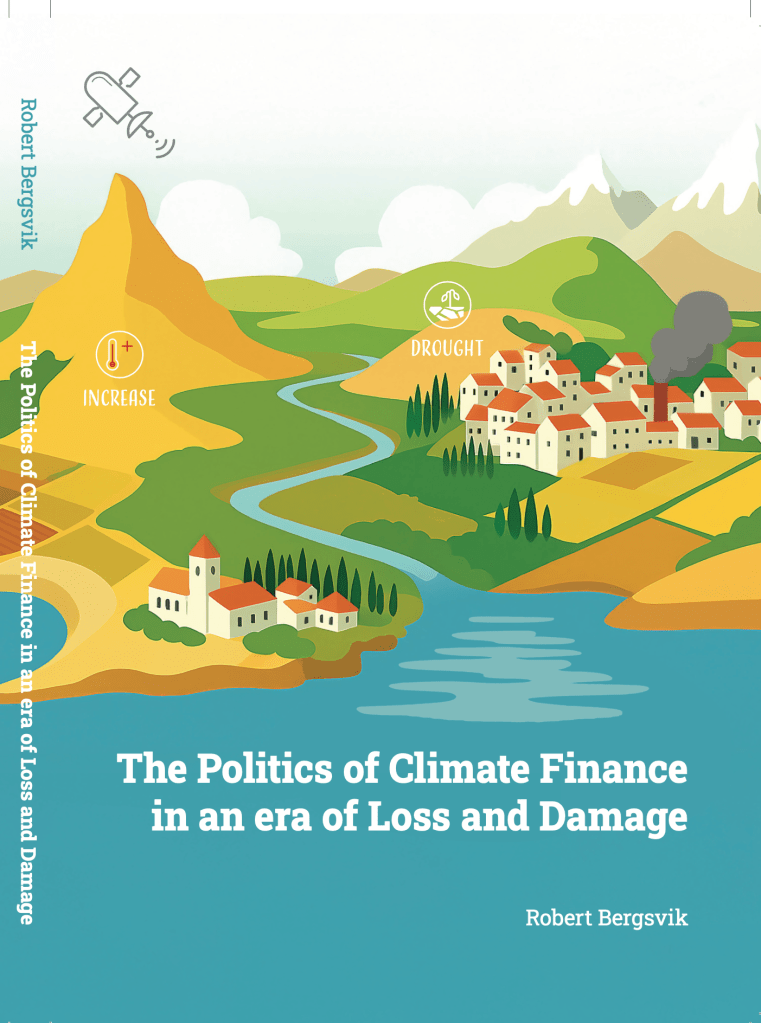
The Politics of Climate Finance in an Era of Loss and Damage
Robert Bergsvik (September, 2025)
Rising temperatures are causing irreversible losses, intensifying disputes over climate finance under the UNFCCC’s Common but Differentiated Responsibilities principle. At COP27, debates about ‘loss and damage’ sharpened these tensions. This PhD thesis critically examines how climate finance is shifting from grants toward mechanisms like satellite-enabled parametric insurance, which reframe disasters as technical problems and shift authority to external actors and technologies—weakening equity and obscuring political causes.
Between a rock and a hard place: unpacking India’s engagement in UNFCCC transparency arrangements
Max van Deursen, Aarti Gupta, Sumit Surendra Prasad & Romain Weikmans (2025, July)
In this article, we examine India’s engagement with UNFCCC transparency arrangements. We identify three coexisting perspectives on the merit of engaging in these arrangements—embracing, strategic, and dismissive—and show how these perspectives shape both the content and process of reporting.
Making transparent the accountability deficit in the global climate regime
Aarti Gupta & Max van Deursen (2025, June)
In this commentary, we unpack an illustrative case where UNFCCC transparency reports revealed politically salient information about climate performance of developed countries. We subsequently followed the UNFCCC negotiations about these reports to see how the multilateral process dealt with this information. We conclude that the use of transparency reports to enhance accountability may often fail to materialize in practice.
Climate transparency’s unmet promises: A necessary stocktaking
Aarti Gupta, Harro van Asselt, Max van Deursen, Rohan Agarwal, Robbert Biesbroek, Romain Weikmans, Rahwa Kidane, Heather Jacobs, Sumit Prasad, Robert Bergsvik, Emilie Broek, Ellycia Harrould-Kolieb & Hyeyoon Park (2025, April)
The Paris Agreement’s enhanced transparency framework is now being implemented, starting in 2024, yet little is known about what transparency systems before Paris have delivered. In this article, we scrutinize the extent to which core promises associated with transparency have materialized to date, with implications for the new transparency system.
Is Enhanced Transparency the “Backbone” of the Paris Agreement? A Critical Assessment
Max van Deursen & Aarti Gupta (2024, November)
In this article, we explore the politics, detailed provisions, and implications of evolving transparency arrangements within the international climate regime. Transparency is hailed as the “backbone” of the Paris Agreement: this article is one of the first to critically examine this claim. Rather than seeing transparency as an inherent force for good, we show here that UNFCCC transparency rules are a complex site of politics, reflecting broader political differences in the global climate regime around ambition and burden-sharing, with the devil often in the details.
Click here for a five-minute video explainer on this new publication.
Is transparency furthering clarity in multilateral climate governance? The case of climate finance
Robert Bergsvik, Aarti Gupta, Romain Weikmans & Ina Möller (2024, November)
In this article, we draw on a little-examined source of self-reporting by countries under the UNFCCC to shed light on persisting climate finance controversies. We find that clarity remains elusive on climate finance provided and received under the UNFCCC, a situation that seems likely to continue under the Paris Agreement’s enhanced transparency framework, due to be implemented in 2024.
Robert Bergsvik & Sanneke Kloppenburg (2024, September)
In this article, we investigate the entanglement of satellites and parametric insurance for climate disasters. We argue that such entanglement intensifies the depoliticization of climate disasters and further compromises climate justice. This development in climate risk governance is crucially relevant to consider in the ongoing Loss and Damage Finance negotiations in the UNFCCC.
Max van Deursen & Aarti Gupta (2024, April)
In this article, we examine the contestations and compromises that underpin the Paris Agreement’s enhanced transparency framework, with the aim to analyze whose climate action priorities are reflected in these arrangements. We find that many of the compromises reached on the scope of the enhanced transparency framework, but perhaps even more so in its subsequent operationalization, marginalize certain aspects of reporting and review that are of the highest priority to developing countries.
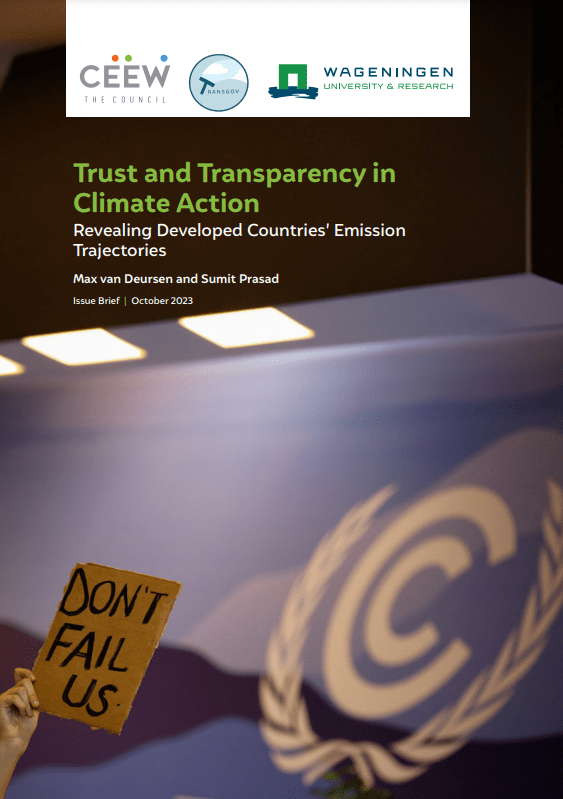
Trust and Transparency in Climate Action: Revealing Developed Countries’ Emission Trajectories
Max van Deursen & Sumit Prasad (2023, October)
In accordance with UNFCCC transparency arrangements, developed countries are mandated to biennially report on their past and projected emissions. This issue brief demonstrates how leveraging this information can provide valuable insights into the performance of developed countries on their climate targets.

The advent of ‘radical’ transparency: Transforming multilateral climate politics?
Aarti Gupta (2023, January)
Advances in satellite-based monitoring enable generation of ever greater volumes of novel data in ever greater detail in almost real time. This article lays out a research agenda to assess the effect of such new forms of transparency for multilateral climate politics.
Susanne Konrad, Max van Deursen & Aarti Gupta (2021, October)
With transparency becoming ever more central to global climate governance, much attention is being devoted to building the capacity of developing countries to participate in UNFCCC transparency arrangements. We argue that rather than merely a neutral ‘means of implementation’, capacity building has the potential to influence the scope and extent of transparency generated by countries.
Romain Weikmans & Aarti Gupta (2021, April)
We generate a first systematic overview here of the nature and extent of country engagement with and adherence to UNFCCC transparency requirements. Drawing on extensive primary documents, including national reports and technical expert assessments of these reports, we generate ‘Transparency Adherence Indices’ for developed and developing country Parties to the UNFCCC.
Aarti Gupta, Sylvia Karlsson-Vinkhuyzen, Nila Kamil, Amy Ching & Nadia Bernaz (2021, January)
Securing accountability of states for their climate actions is a continuing challenge within multilateral climate politics. This article analyses how novel, face-to-face, account-giving processes for developing countries, referred to as ‘Facilitative Sharing of Views’, are functioning within the United Nations Framework Convention on Climate Change (UNFCCC) and what these processes help to shed light on.
Databases

Database and dashboard of CBIT Projects
Max van Deursen (2022, March)
What type of reporting capacities are being prioritized in capacity building initiatives? This database contains information about funding requests by developing countries to the Capacity Building Initiative for Transparency (CBIT) disaggregated by four areas of reporting (greenhouse gas inventory, mitigation, adaptation, and support). More information about the database is provided in this blogpost. The database can be used freely (if cited) for future research.
Database Transparency Adherence Indices
Romain Weikmans & Aarti Gupta (2021, April)
How have countries adhered to reporting requirements under the UNFCCC? This database contains information on developed and developing countries’ adherence to reporting requirements of the UNFCCC. More information about the database is provided in this blogpost.
Related publications on transparency from TRANSGOV members
Below are selected publications by TRANSGOV team members prior to the start of the project. These publications provide context for our work and outline research gaps that we seek to fill.




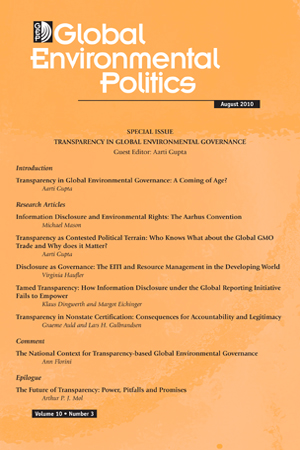
For blog posts related to the work of TRANSGOV, click here.
For videos of TRANSGOV members explaining their research on transparency, click here.
 TRANSGOV